




For a few brief hours, the city believed it had survived.
The clouds that had smothered the sky for months finally broke apart. A pale orange glow appeared over the ruins of the Pacific. The endless rain stopped. Emergency broadcasts returned to the airwaves. Across the Lower Mainland, survivors emerged from tunnels, basements, and shattered towers to witness something many had forgotten existed — sunlight.
Children pointed toward the horizon.
People cried.
Some even laughed.
From the remains of Metrotown to the flooded streets of Richmond, from the silent towers of Downtown Vancouver to the dark forests reclaiming Coquitlam, a fragile hope spread through the wasteland.
The war was over.
Or so they believed.
At 08:17 AM, every functioning radio frequency began transmitting the same signal.
No voice.
No warning.
No language known to humanity.
Only a low mechanical pulse repeating across the continent.
Then the sky changed.
The orange dawn turned crimson.
The clouds folded inward as if the atmosphere itself had been torn open.
Thousands watched in silence as enormous shadows appeared above the mountains north of Burrard Inlet.
The surviving satellites vanished.
The power grid collapsed again.
And one by one, the emergency broadcasts fell silent.
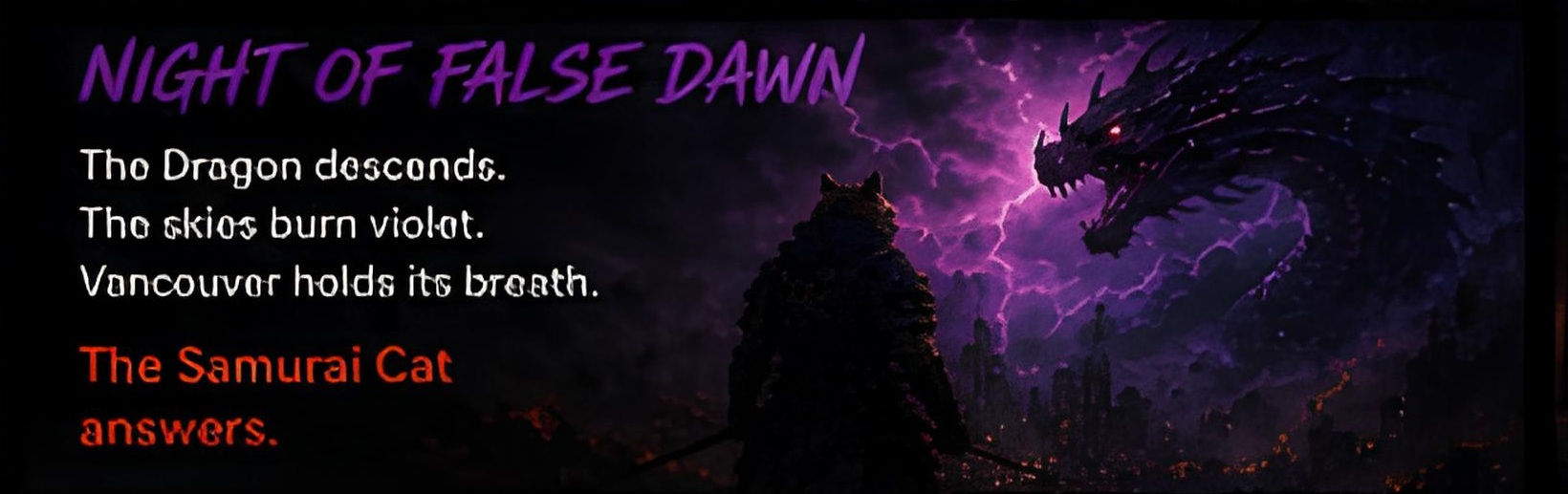
What came next became known as the Night of False Dawn.
The day hope died for the second time.
Entire districts disappeared without a trace. The last military strongholds around Surrey and Abbotsford stopped responding. Fires consumed the remains of Burnaby. The waters around False Creek began to glow with an unnatural blue light visible for hundreds of kilometers.
No one understood what had arrived.
No one knew how to fight it.
The age of survival was ending.
The age of extinction had begun.
And somewhere within the ruins of Vancouver, a legend was preparing to rise.